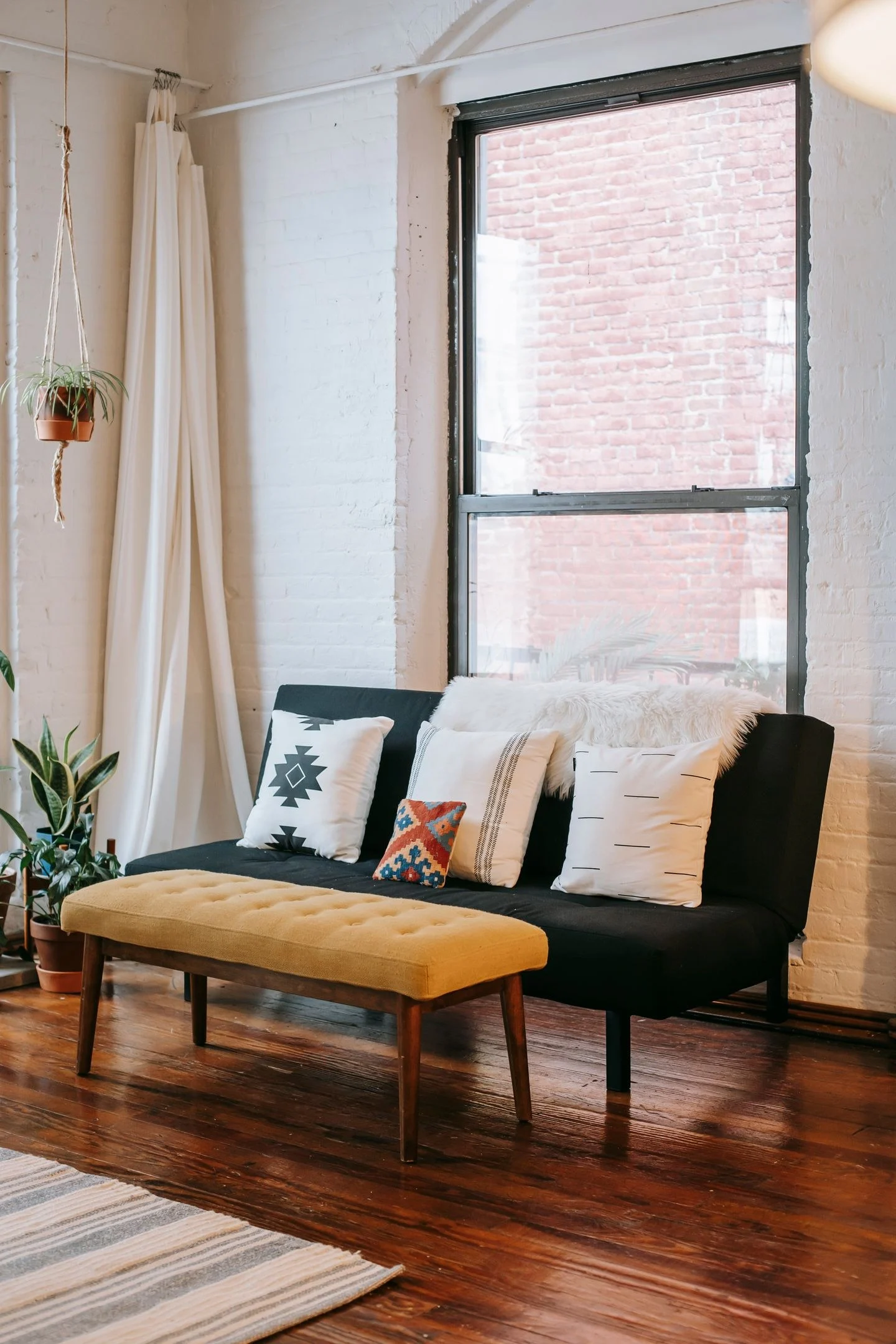
A bench can provide an extra place to sit without the visual bulk of another armchair. It works particularly well for short conversations or gatherings where people move between rooms. It is less convincing as the main seat for someone who wants back and arm support all evening.
Choose a bench explicitly designed for seating and follow its load and use instructions. A narrow console or storage chest should not become a bench simply because its height looks suitable. Test the seat if possible, including how easy it is to stand up from it.
Decide where it belongs between gatherings
A useful bench has an ordinary position as well as a guest position. It might sit along a quiet wall, beneath a window that remains accessible, or at the edge of the seating group. Avoid a parking spot that blocks a door or requires moving the bench every day.
If you plan to carry it across the room, consider its weight and whether one person can move it safely. A solid upholstered bench may be less flexible than two lightweight chairs. Protect the floor with appropriate glides, and lift or move the piece according to its construction rather than dragging it by a delicate arm.
Give it a relationship to the sofa
A bench opposite a sofa can keep sightlines open, particularly in a room with a view behind it. A bench at a right angle can complete a conversation group. In both cases, allow a usable approach and keep the central table reachable without trapping the sitter's knees.
An upholstered seat introduces softness, while wood or woven seating can provide texture. If adding a cushion, check whether it stays securely in place and whether the resulting height is comfortable. A loose cushion that slides off each time someone stands will quickly become irritating.
A bench used as a coffee-table substitute needs a separate assessment. Some seats are too soft or narrow for a stable tray, and setting drinks on them can conflict with their seating role. Keep a small table nearby when the bench is occupied.
Leave the surface mostly clear. A bench covered with books, pillows, and a large vase no longer offers spontaneous seating. One removable cushion or throw may be enough to connect it with the room while leaving its main purpose available.