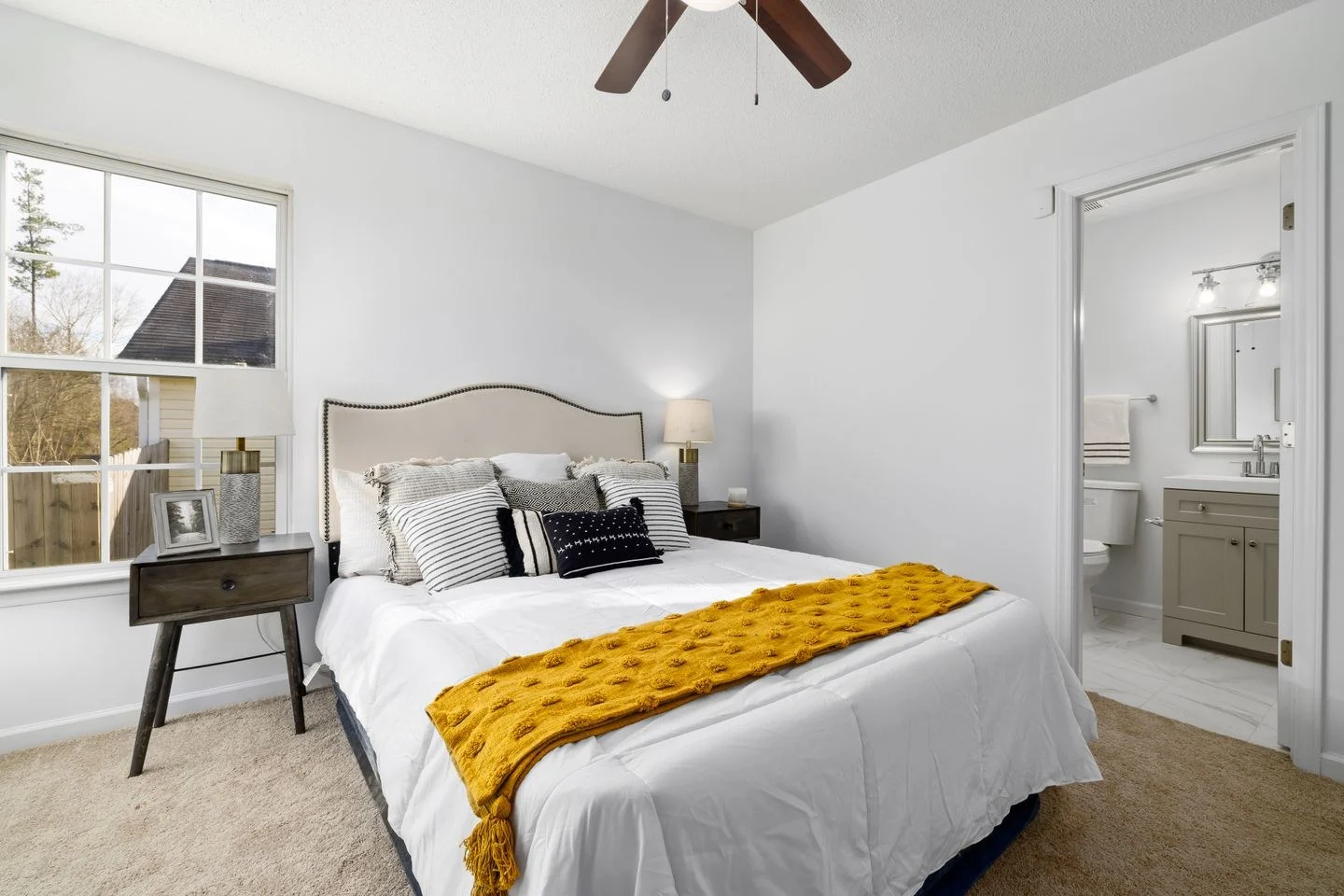
A dresser offers an appealing straight line to start with: place it on the longest wall, then fit everything else around it. In a bedroom, however, that can leave the bed squeezed beside a door or force one person to climb past the other. Give the bed its position first. The dresser can change shape, move into a closet, or hold fewer categories of clothing. The bed has fewer substitutes.
Draw the room with its moving parts
Measure the walls, window positions, door openings, and closet fronts. Mark the sweep of hinged doors rather than drawing only their closed position. Include radiators, vents, and other fixed obstructions. A useful plan shows where something cannot go as clearly as where it might fit.
Next, draw the actual bed frame. Mattress dimensions alone omit projecting rails, an upholstered headboard, and a footboard. Two frames holding the same mattress can have noticeably different footprints. If you have not chosen one, compare their outside dimensions before deciding that a larger bed will fit.
Cut a paper rectangle to scale and try it on each plausible wall. Look for a place that permits the people using the bed to enter, leave, and make it comfortably. Keep access to windows and required exits clear. A centered headboard is pleasant, but an easy route into the room matters more than perfect symmetry.
Test the routes you will use twice a day
On the floor, outline the candidate frame with removable tape suitable for the surface. Walk from the doorway to the closet, then around each side of the bed. Carry a laundry basket through the same route. The exercise exposes awkward corners that can look harmless on a small drawing.
Account for the motion of storage, too. A drawer under the bed needs its full extension and space for a person to stand or crouch beside it. Room & Board's bed planning guidance specifically distinguishes storage-bed clearance from the space occupied by the closed frame. Treat any generic spacing suggestion as a starting point; the actual drawer and household access needs determine the usable result.
Let the remaining wall choose the dresser
Once the sleeping zone works, measure the leftover storage location. A broad, shallow dresser and a narrower chest answer different problems. Record drawer extension, not just case depth, and check whether the top can be used without blocking a switch or window. Follow the furniture maker's anchoring instructions.
Do not buy a matching set simply to fill the available walls. A bedroom may work better with a modest dresser, one closed nightstand, and seasonal clothing stored elsewhere. In another room, a long low dresser may replace several smaller pieces and leave a quieter outline.
Finish by placing only the objects that support the routine: lighting within reach, a surface for a glass, somewhere for the current book, and a landing place for clothing. If a bench at the foot consumes the only comfortable passage, leave it out. A bedroom is complete when its ordinary movements are easy, even if one wall remains largely empty.