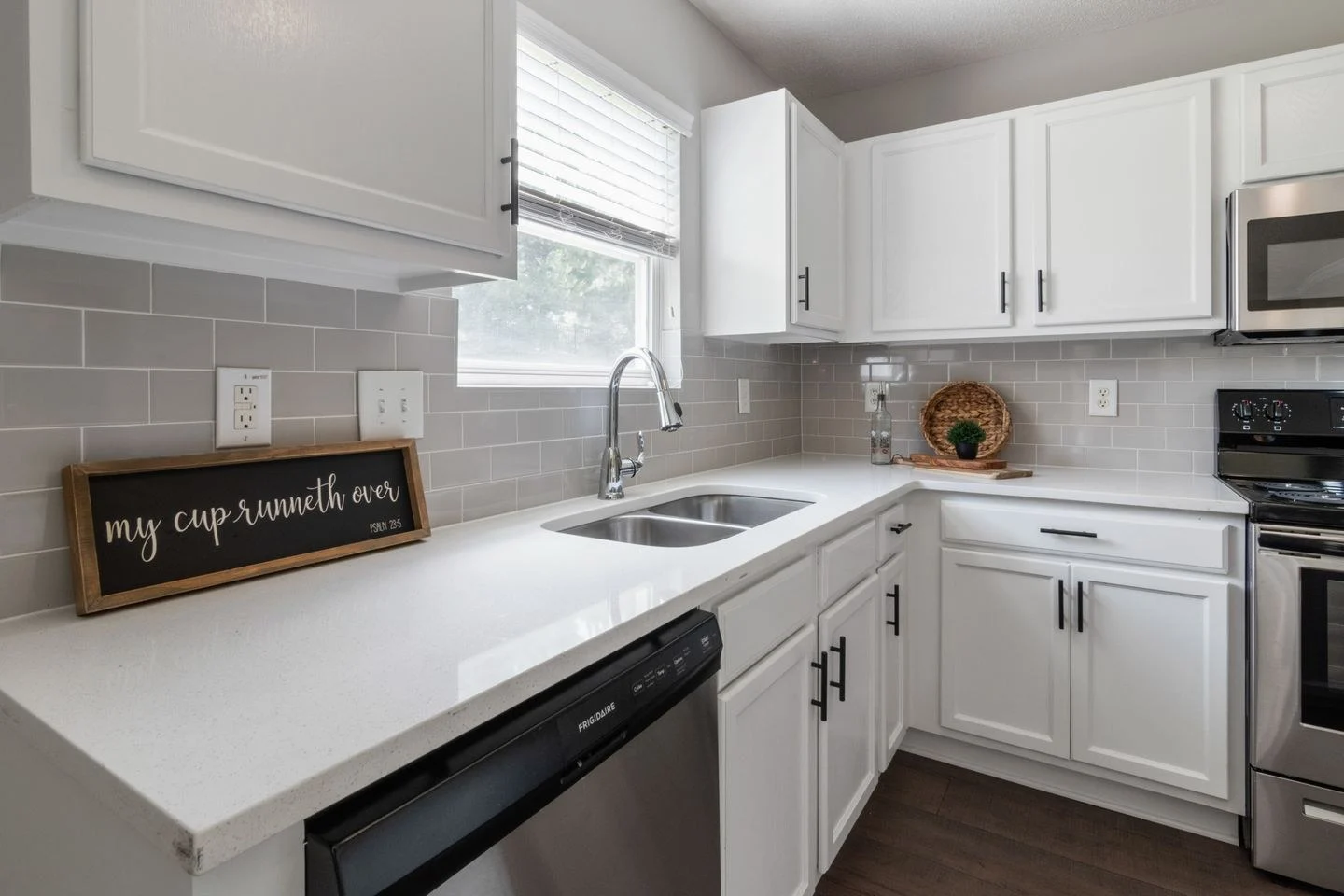
An existing countertop is a useful limit when choosing a backsplash. It narrows the palette and gives the new surface something concrete to relate to. Bring tile samples to the kitchen before deciding on a pattern from an isolated showroom display.
First identify the countertop's dominant appearance from normal standing distance. A stone or patterned surface may contain many small colors, but one background tone and one movement usually lead. A solid counter leaves more room for the backsplash to carry pattern; a strongly veined counter may benefit from a quieter neighboring surface.
Compare samples vertically
Stand the tile sample against the wall in its intended orientation. A sample lying flat on the counter receives different light and can give a misleading impression. View it beside the cabinets, at an inside corner, and under any existing counter lighting.
Check undertones before trying to match exact color. A creamy tile beside a cool white countertop can look intentionally warm or unexpectedly yellow, depending on the room. A gray tile may contain blue, green, or violet notes that become clearer next to the counter. Compare more than one sample rather than committing to the first approximate match.
If both surfaces have movement, look at their scale. Fine repeated tile joints can compete with small busy speckles, while a larger simple tile may give the countertop's pattern space. A bold tile can still work, but it should be a deliberate second feature rather than an accidental near match.
Include the grout and boundaries
Tile is not the whole backsplash. Grout color changes how clearly the pattern is outlined. A close color creates a more continuous field; a contrast emphasizes the grid or shape. Ask to see a sample that includes the intended joint and finish where possible.
Plan where the backsplash begins and ends. Exposed edges, windows, outlets, cabinet ends, and changes in wall height all affect the result. A complicated tile shape can be difficult to resolve neatly at a short exposed end. Discuss these details with the installer before ordering, including suitable trim and substrate preparation.
Do not assume that every decorative tile or adhesive product is appropriate behind every cooking appliance. Check the material's intended application and the appliance manufacturer's requirements. Installation near heat, water, outlets, or other services needs suitable materials and qualified help where required.
Read the care guidance for the tile, grout, and any sealant as a complete system. A textured surface may have a different cleaning routine from a smooth glazed tile, while natural stone may have additional requirements. Daltile's backsplash range illustrates the variety of available materials; the individual product information should guide suitability.
Leave the sample in the room through several lighting conditions before finalizing the choice. The right relationship should remain convincing while you prepare breakfast, cook dinner, and look into the kitchen from the next room. A backsplash succeeds when it connects the existing surfaces and can be maintained in the place it occupies.