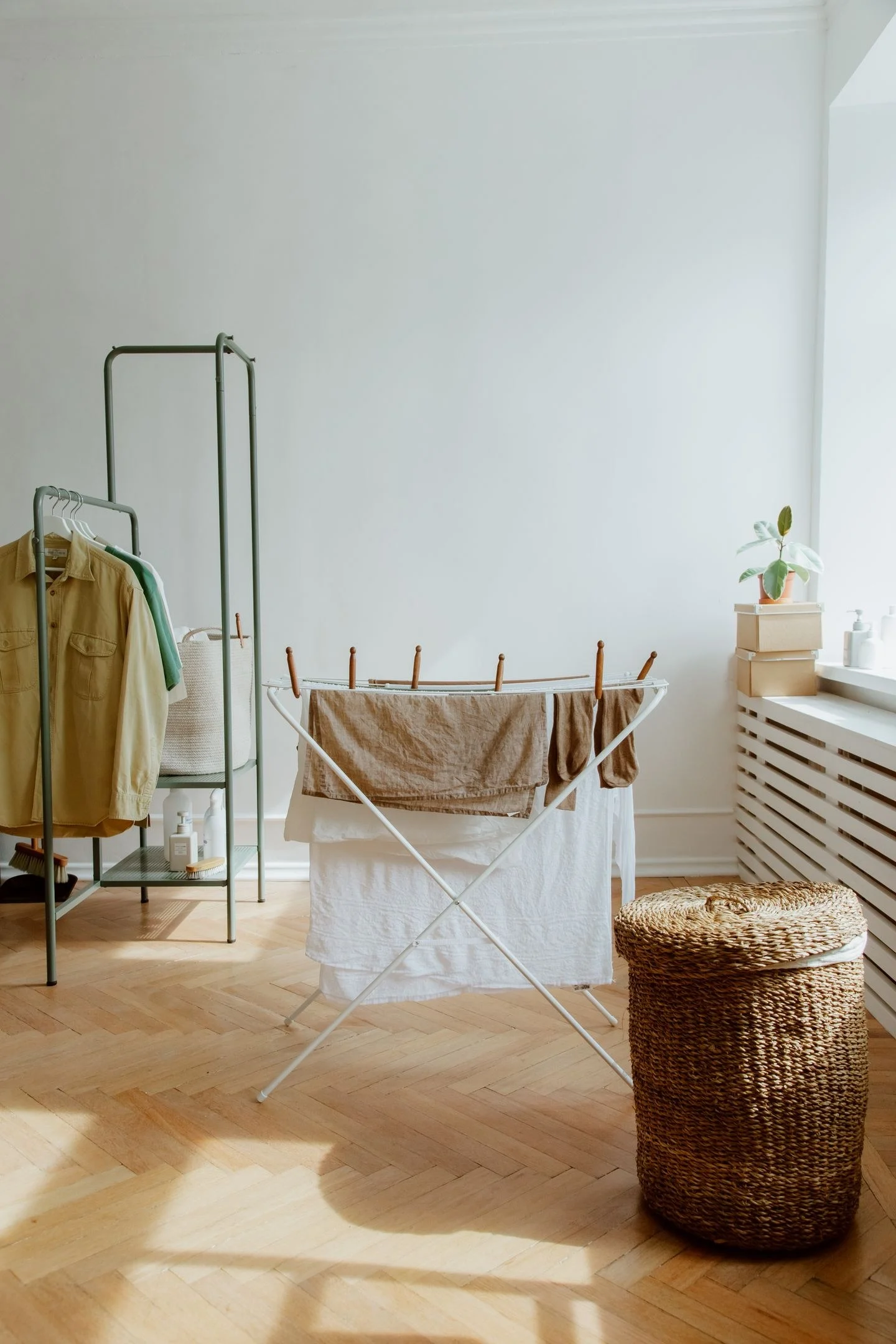
A laundry corner needs a sequence: collect, sort, wash, dry, and return. When one stage has no place, clothes tend to collect on the nearest chair or appliance top. Start by identifying the missing stage rather than adding baskets at random.
Keep the appliance clearances, ventilation, service access, and installation requirements intact. Storage should fit around those requirements, not conceal or compress them. Use the appliance manuals and qualified help for any installation changes.
Sort only as much as the routine needs
Choose categories that match how the household actually washes. Too many small hampers can consume space without making decisions easier. Labels can help if several people contribute laundry, but the labels should describe a useful sorting action rather than a decorative theme.
Check how a full container will be carried. A tall narrow hamper may fit a gap but be awkward to lift through a door. Removable bags or smaller baskets can make transport easier, provided they suit the weight and use.
Separate supplies from clothing
Keep detergent and other products in their original labeled containers, stored according to their instructions and away from children and pets. Do not transfer them to decorative jars that obscure the contents or directions. A closed cabinet may be more suitable than an open shelf depending on the household.
IKEA's laundry storage guidance uses vertical cabinets and shelving to conserve floor area. Apply that approach without placing frequently used supplies beyond comfortable reach. Heavy products need a manageable location, and shelves must be installed for the intended load.
Give clean clothing a destination. A clear folding surface or portable basket can prevent it from mixing with incoming laundry. If folding happens elsewhere, plan the transport and return step rather than expecting the laundry corner to do every job.
Leave one small area unassigned for temporary handling. A system filled to capacity before a wash begins has no flexibility when bedding or an unusually large load arrives. The aim is a repeatable sequence that the whole household can follow, with storage supporting the process instead of becoming another place for unfinished piles.