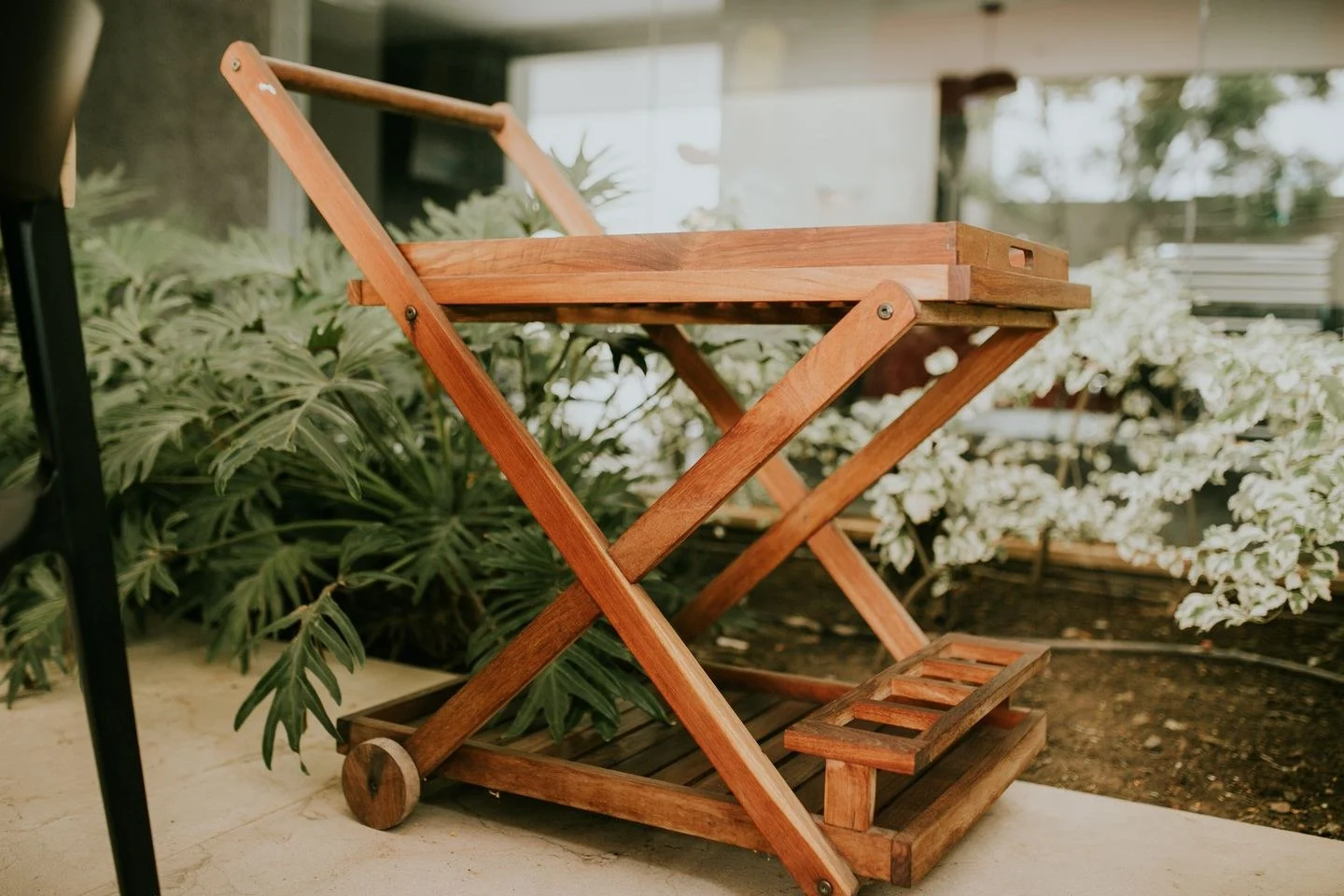
A rolling kitchen cart is only flexible if it has somewhere to go. Before comparing finishes and shelves, identify both its everyday parking place and the location where you would use its work surface.
Draw two footprints
Measure the cart at its widest points, including handles, towel bars, and any projecting top. Mark its parked outline and its working outline on the floor. Then open the refrigerator, dishwasher, oven, and nearby cabinets. The cart should not make an appliance usable only after several other objects are moved.
Include the person working at it. A narrow cart in the middle of the room can consume a much wider area once someone stands beside it. If the kitchen is also a route to another room, test that movement while the cart is occupied.
Choose between storage and preparation
A cart used primarily for pantry overflow may need enclosed or contained shelves. A preparation surface needs appropriate height, stability, and a top suitable for the intended task. Do not assume every utility trolley is designed for food preparation or heavy appliances.
Read the care instructions for the exact surface. IKEA's FORHOJA cart, for example, has an oiled wood top with its own maintenance requirements. That does not mean a painted, laminated, or metal cart should receive the same treatment. Use cutting boards and protective surfaces as directed rather than treating the cart top as universally resistant to heat or moisture.
If you plan to use an appliance on the cart, check the cart's load capacity and the appliance's placement, ventilation, and power requirements. A rolling object with a trailing power cord can create a problem the extra counter space does not justify. Reconsider the use if it requires a cable across a passage.
Assess the movement itself
Check the wheel arrangement and any locking mechanism. Some carts roll in a limited way or require tilting; others move freely on casters. The floor surface, thresholds, and weight of stored items affect how manageable the cart will be. Follow the manufacturer's loading and movement instructions.
Store heavier items only where the cart's design permits, and avoid unstable stacks. A towel hanging from a side bar adds to the operating width. A basket projecting beyond a shelf can catch as the cart moves.
Give the parking place a visual role too. Against a quiet wall, a cart can look intentional with a restrained set of everyday items. In the center of the kitchen, it needs to earn the floor space repeatedly. If it stays parked because moving it is inconvenient, a fixed shallow cabinet may be a better long-term solution.