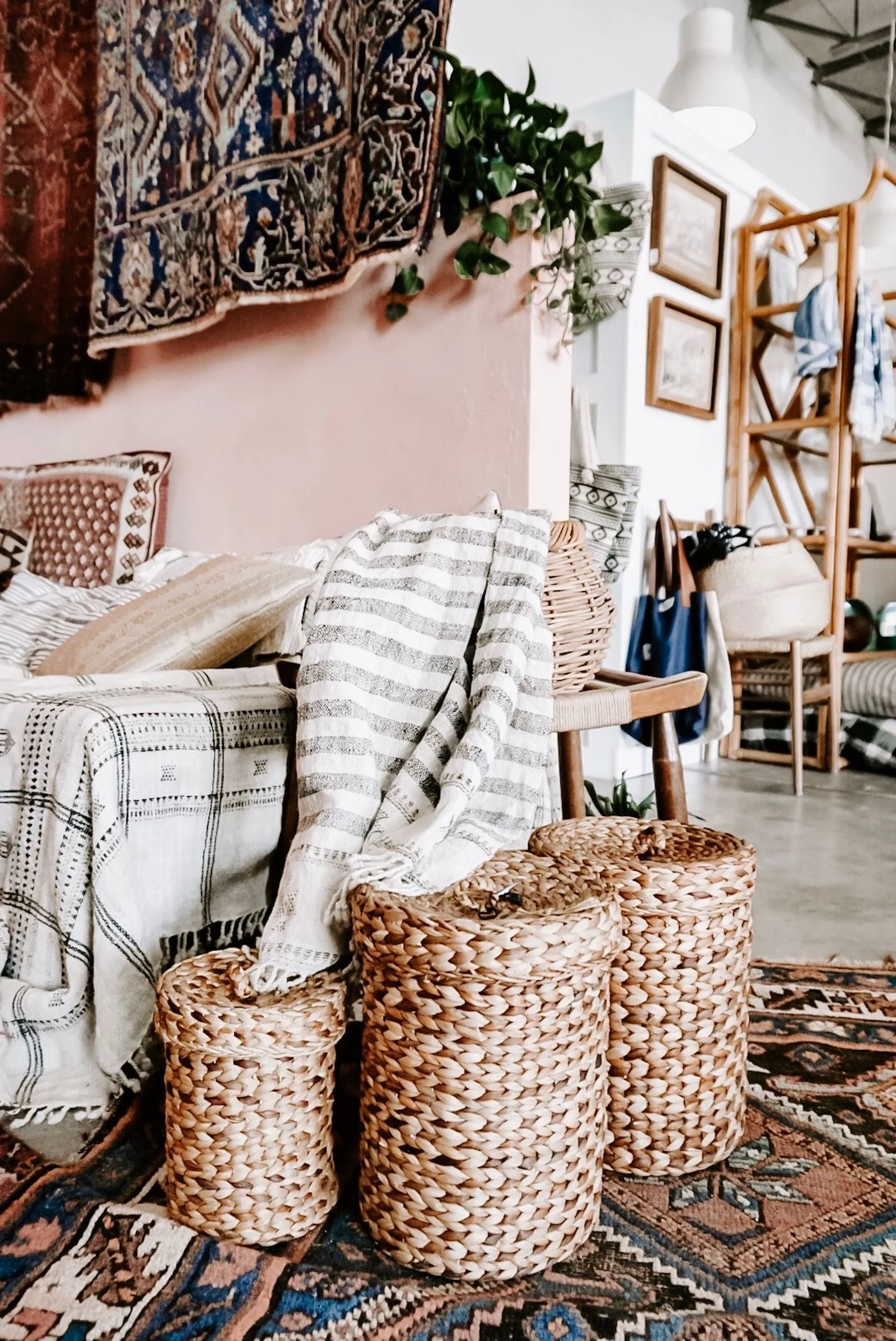
Cane, basket weave, a chunky rug, and textured upholstery can each add character to a room. Together, they may create more visual activity than expected, even when every item is beige. Texture needs contrast just as color does.
Choose the largest woven surface as the starting point. If the rug has a strong braided pattern, let the sofa fabric and curtains be quieter. If cane-front cabinets are the main feature, a smooth tabletop can provide a useful pause beside them. You do not need a woven object in every corner to establish the material.
Vary the scale you can see
A fine, tight upholstery weave reads differently from an open basket or broad cane pattern. Combining these scales usually gives the eye more variety than repeating several equally coarse textures. Look from the doorway, where small details may disappear but broad patterns remain visible.
Consider color differences within the materials. Pale straw, golden rattan, and reddish wicker are not the same neutral. Hold samples or small pieces together beside the room's wood finishes. A shared tone can connect them, while a stronger contrast can be intentional if repeated elsewhere.
Shape also affects the result. A round woven basket beside a rectangular cane cabinet can feel more varied than several square woven boxes arranged in a row. Leave enough plain wall or floor around the group for the individual shapes to remain readable.
Keep the material suited to its task
A basket for soft blankets should have an interior that will not snag them. A woven seat needs to be designed for seating and used within its stated limits. Do not treat a decorative object as structurally interchangeable with a similar-looking functional piece.
Read care instructions for moisture, cleaning, and sunlight exposure. Materials that look alike may be natural fiber, synthetic fiber, or a combination, and their care can differ. Keep delicate woven pieces away from situations they are not designed to handle.
Edit the final arrangement by removing one texture at a time. If the room becomes clearer when a basket or throw leaves, it may not need a replacement. Woven materials are most effective when their texture can be noticed rather than lost in an uninterrupted field of similar surfaces.